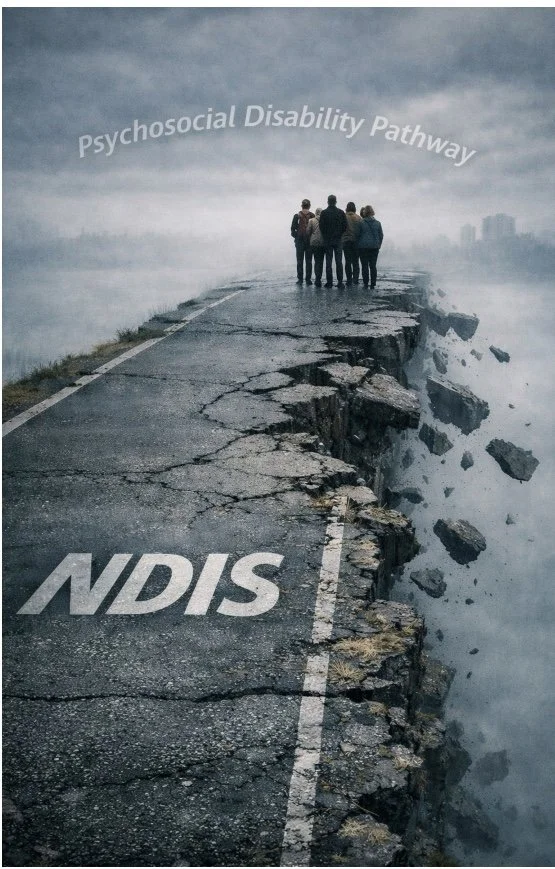
Many People with Psychosocial Disability in Jeopardy in the NDIS
An APDC Response to Current NDIS Budget Directions
Thousands of NDIS participants with psychosocial disability are at risk of reduced supports or removal from the scheme due to a convergence of budget directions, policy shifts, research narratives, and administrative changes that collectively threaten the rights and wellbeing of this group.
For the Australian Psychosocial Disability Collective (APDC), a grassroots, lived-experience systemic advocacy group, this moment represents a rollback of hard-won disability rights and carries serious risks of harm to people.
Heavy cuts to plans and removals from the NDIS for people with psychosocial disability would have profound human consequences. They would increase crisis, hospitalisation, homelessness, and suicide risk. They would shift costs to emergency systems and families. Most importantly, they would harm people whose lives are already impacted by trauma, poverty, stigma, and systemic barriers.
Health and NDIS minister, Mr Mark Butler has announced that the Federal Government will remove 160,000 participants from the NDIS by 2030 as a budget “savings” measure aimed at ensuring the sustainability of the scheme, currently running at $50 billion per year.
Presently, about 66,000 NDIS participants have psychosocial disability, or about 9 per cent of all participants. About 5.8 billion a year is spent on supports for this group, or about 11 per cent of NDIS spending, which represents a relatively small group with high support needs.
Policy settings are tightening access, reducing plan budgets, and increasing reassessments. Many participants across various disability types are expected to lose their individual support plans and be moved onto yet-to-be-established “Foundational Supports” or no supports at all. Mr Butler has previously said that the psychosocial area would be the next to be looked at after children with “mild to moderate” developmental delays and Autism, who will be subject to a new Thriving Kids program as an alternative to the NDIS.
New standardised assessment tools risk turning complex lives into simplified scores that are easier to cut than to understand. There is a coming requirement that all providers be registered, claimed to be able to improve the integrity of the scheme, but can threaten trusted relationships and flexibility and limit choice and control, which was a hallmark of the original design of the scheme.
Supports for social and community participation are being scaled back, despite being critical for preventing social isolation and increased disability challenges.
Overlaying this is a set of ableist assumptions—that people can simply “recover” if supports are reduced, that needs are milder and more fluctuating than other disability types, and that mainstream mental health services can meet the support needs of people with psychosocial disability, despite never having been designed or resourced to do so.
Together, these forces narrow who gets support, reduce what support looks like, and weaken the systems people rely on to survive. The result is not reform—it is a convergence of risks that increases the likelihood of people falling into crisis, homelessness, and long-term harm.
Psychosocial disability is real disability and should be treated equally in the NDIS
Several research reports and papers being used to back policy changes seem to be implying that psychosocial disability is undeserving or ill-fitting as a disability type under the NDIS, effectively seeking policy segregation. We maintain that psychosocial disability is real disability and should have equal rights in the NDIS.
Research reports which our group has examined include the Grattan Institute report “Saving the NDIS”; “A Proposed Targeted Model For Foundational Supports,” by Jennifer Smith-Merry of Sydney University; and the “Access Denied” report by the Australian Psychosocial Alliance which represents provider NGOs.
The Grattan Institute’s push to strip $2 billion annually—a reduction of some 40 to 60% of NDIS psychosocial disability funding—and shift it into a yet-to-be-established Foundational Supports system, claiming to be able to serve more people with psychosocial disability at no extra cost, and produce “recovery” outcomes, while “saving the NDIS” is deeply flawed both logically and ethically. This move would displace tens of thousands of vulnerable people from the scheme currently meeting their serious, enduring, and complex needs. It gambles on a hypothetical replacement while withdrawing hard-won, life-sustaining support.
The Grattan research and the Smith-Merry research both imply that psychosocial support does not need to be as intensive as other types of disability support, thus being readily replaceable with Foundational Supports. The APDC rejects these notions.
The APA report proposed block funded centre-based “recovery oriented” programs by consortia of organisations, with locally determined service provision.
These research reports each refer to “recovery” oriented approaches in the psychosocial area to allow many participants to be moved off the scheme and to receive cheaper Foundational Supports instead of individualised support plans. These would not include support in the home, social and community participation, or capacity building therapies.
Grattan’s proposals misuse the language of recovery as a justification for exit, suggesting that "recovered" individuals can be discharged from the NDIS. This is deeply problematic. It ignores the severe, complex and enduring nature of psychosocial disability, shaped by trauma, poverty and instability of living conditions.
The recovery movement, led for decades by consumers and survivors, has never meant an end to supports — it means increased control over one’s life, access to chosen supports, and freedom from institutionalisation. The NDIS was originally intended to support people with disabilities to have ordinary lives, while living and participating in the community.
Psychosocial participants, to be on the scheme, have been assessed as having permanent disability, and the posited form of non-clinical “personal recovery” would be extremely difficult or impossible for participants to achieve. For many participants, survival, stability, and maintenance of community living are realistic and valuable outcomes with properly funded supports from the NDIS. For example, help with daily routines, transport, housing stability, meal preparation and nutrition, and social and community participation are essential life supports and help prevent crisis and increased disability challenges.
Dispelling misconceptions about psychosocial disability
A major misconception underpinning many reform discussions is the conflation of psychosocial disability with mental illness alone.
Psychosocial disability arises from the interaction between mental health challenges and social, economic, cultural, and environmental barriers. It is long-term, complex, and associated with co-occurring physical health conditions, higher mortality, and elevated suicide risk. It is recognised disability under the NDIS and under the UN Convention on the Rights of Persons with Disabilities (CRPD).
Automation, Assessments, and Quiet Exits
New assessment tools and automated planning processes raise additional concerns.
Simplified assessment tools and automated planning processes cannot capture cumulative trauma, long-term vulnerability, or contextual needs. Psychosocial disability evidence is often narrative, relational, and longitudinal. When decisions rely heavily on scoring systems or algorithms, lived experience is flattened into numbers.
New needs assessment methods for entering and maintaining NDIS coverage are coming in April next year with a new assessment tool called I-Can which will be administered by lay person officials rather than allied health professionals, and in the name of simplifying the system, will combine needs assessment with budgeting considerations and not necessarily require the NDIS to consider official reports by therapists and treating agents. According to recent reports, under the new changes NDIS plans will be computer generated by algorithms and appeals largely removed.
Eligibility reassessments for all NDIS participants will be held by the NDIA by 2030 under legislation which has the main purpose of budget cutting. The legislation’s rules also define what are and are not NDIS supports, provide for price caps on therapies, redefines the key concept of reasonable and necessary supports into reasonable and necessary budgets, and brings in whole of person support templates which advocates say make complex needs more difficult to address and risk simplification. The legislation also tends to erode the key NDIS principle of choice and control.
This creates real risk of:
● Under-assessment of need.
● Budget-driven plan reductions.
● Increased reassessment churn.
● Quiet administrative “exits” from the scheme.
This would lead to unfair outcomes rather than efficiency. The role of allied health professionals in these processes should be preserved.
Human rights obligations
Australia is a signatory to the UN Convention on the Rights of Persons with Disabilities (CRPD). Removing psychosocial participants from the NDIS without adequate, rights-based alternatives risks breaching:
● Article 3 – autonomy and freedom to make choices.
● Article 19 – living independently and community inclusion.
● Article 25 – the highest attainable standard of health.
● Article 28 – social protection and economic inclusion.
Policy shifts that reduce supports without proven alternatives are regressions.
The Real Reform Needed
APDC supports genuine reform that strengthens systems and reaches more people. But reform must not be built on disinvestment, displacement, or false economies.
Real reform would include:
● Guaranteed psychosocial supports both inside and outside the NDIS.
● Co-design with lived experience leadership, not token consultation.
● Peer-led models and community-controlled responses.
● Transparent safeguards against plan erosion and quiet exits.
● Staged, evidence-based transitions—not budget-driven timelines.
Our Demands
IMMEDIATE
No participant with psychosocial disability loses access unless an equal or better support system is already functioning.
No forced exits under the banner of “recovery pathways”.
Restore appeal rights with human review and independent oversight.
Suspend automation in psychosocial decision-making until safeguards and bias testing are proven.
Protect self-management and choice — do not remove autonomy based on profiling.
STRUCTURAL
Psychosocial disability must remain a recognised disability category with equal legal status.
Separate disability support from clinical mental health care in law and practice.
Fund specialist advocacy and navigation services nationwide.
Guarantee foundational supports in legislation, not policy statements.
Invest in co-designed eligibility assessments that reflect psychosocial realities.
Ensure that any Foundational Supports system includes funded psychosocial supports — not just advice or signposting.
Reform interface issues with justice, health, and homelessness — not punish participants for systemic failures.